
The University of Maryland School of Pharmacy's PharmD M-Pact curriculum is a competency-based educational program designed to prepare practice-ready pharmacists who can lead, innovate, and respond to the evolving needs of patients and health care systems. Through an integrated and learner-centered approach, students progressively develop the knowledge, skills, attitudes, and professional judgment required for contemporary pharmacy practice.
Over six semesters of didactic coursework, students engage in active and applied learning experiences focused on medication expertise, patient-centered care, professionalism, pharmapreneurship, applied sciences, therapeutics, and essential pharmacy skills. The curriculum emphasizes the integration of foundational and clinical sciences while fostering critical thinking, collaboration, leadership, self-reflection, and lifelong learning.
Students have opportunities to personalize their educational experience through elective coursework, co-curricular activities, early career exploration, and diverse experiential learning opportunities that align with their professional interests and career goals. Throughout the curriculum, students receive ongoing feedback and support as they progress toward competency milestones and professional growth.
The curriculum culminates in a year of advanced pharmacy practice experiences, where students apply and demonstrate their competencies in authentic patient care and health system environments. Upon graduation, M-Pact learners are prepared to enter the profession as compassionate, equity-minded, and practice-ready pharmacists equipped to improve patient outcomes and advance the future of pharmacy.
Explore the links below to learn more about the different elements of the PharmD program's curriculum.
- Curriculum Overview
- Core Courses
- Elective Courses
- Experiential Learning
- Assessment and Grading in the M-Pact Curriculum
- Dual Degree Programs
Curriculum Overview:
Download an outline of the PharmD curriculum or the PharmD competency-based educational outcomes (CBEOs).
| Year | M-Pact Curriculum Overview |
|---|---|
| Year 1 | The first year of pharmacy school consists of intensive coursework in applied sciences (biochemistry, physical chemistry, cell and molecular biology, medicinal chemistry, anatomy and physiology of absorption, distribution, and elimination, microbiology, and immunology) and foundational pharmacy coursework (Pillars of Pharmacy, Person-Centered Care, Clinical Pharmacology, Foundations of Therapeutics, and U.S. Healthcare). You’ll participate in clinical skills labs and a seminar series that explores important and timely topics in pharmacy practice. After mastery of basic concepts, you’ll learn to apply your knowledge of pathophysiology and pharmacology to single-disease-state pharmacotherapy. You’ll participate in immersive pharmacy practice-related activities throughout the fall and spring semesters to experience and start developing your professional identity. You’ll participate in a three-week community-based experiential rotation during the summer after the first year. |
| Year 2 | The second rigorous year of the M-Pact curriculum continues with the Clinical Pharmacology and Foundations of Therapeutics series that emphasizes therapeutic decision making, as well as infectious disease, pharmacokinetics, drug product formulation, management and leadership, and weekly clinical skills training. During the school year, you’ll participate in immersive introductory pharmacy practice experiences in preparation for a three-week rotation in quality and safety in the health-system pharmacy setting, to be completed during the summer following the second year. |
| Year 3 | The third year of the M-Pact curriculum challenges you with concepts of pharmacotherapy of multiple disease states during the Applied Therapeutics series. Pharmacokinetics, Population and Public Health, Critical Appraisal of Pharmaceutical Evidence, and Pharmacy Law are also emphasized, and weekly clinical skills training continues. There are many paths for you to explore personal areas of interest through a wide variety of electives and dual degrees. You’ll begin advanced pharmacy practice experiential rotations during the summer following the third year. |
| Year 4 | Upon completion of didactic requirements, students complete advanced pharmacy practice experiences (APPEs), participating in full-time, immersive clinical rotations at a variety of practice sites. Required experiences include community pharmacy, health-system pharmacy, ambulatory care, and acute care, along with patient care and non-patient care electives that allow students to explore areas of professional interest. Under the guidance and mentorship of qualified pharmacist preceptors, students apply and refine their knowledge, skills, and professional judgment in authentic practice settings. These experiences provide opportunities to care for patients, collaborate with interprofessional teams, and assume increasing responsibility for medication-related decision-making. Upon successful completion of the M-Pact curriculum, graduates demonstrate the competencies, professional judgment, and commitment to lifelong learning necessary for practice-ready, independent pharmacy professionals. |
Core Courses:
The Foundations of Therapeutics series progresses to Applied Therapeutics and is taken alongside the Clinical Pharmacology series. These courses train you to integrate basic and clinical sciences in the therapeutic decision-making approach to person-centered care. You’ll also explore population-based health considerations for disease states, including health promotion and disease prevention. You’ll be expected to identify discriminating data, analyze patient-specific information at an advanced level, make independent therapeutic decisions, and recommend drug therapy and monitoring parameters across multiple disease states at the conclusion of these series.
Essential Skills for Pharmacy Practice is a series of six courses that help you develop the knowledge, skills, abilities, and attitudes that are essential to function as an independent pharmacy practitioner in a variety of health care environments. You’ll progress through self-paced learning activities, lab activities, discussions, and reflections. You’ll observe, practice, demonstrate, and achieve proficiency on a variety of skills and techniques needed for contemporary pharmacy practice, including verbal communication, medication history-taking, immunization certification, and more.
Elective Courses:
Within the M-Pact curriculum, you’ll be able to tailor your PharmD training by taking unique electives that highlight various practice areas and provide cutting-edge information to best prepare you for practice and your future career.
To learn more about the wide selection of elective courses available to students in the PharmD program at the School of Pharmacy, please explore courses in the Academic Catalog.
Experiential Learning:
The PharmD program focuses on patient-centered care to maximize medication therapy outcomes and assure safe medication use. The goal of the Experiential Learning Program (ELP) is to develop in each student pharmacist the professional judgment and competencies needed to skillfully perform the functions and meet the responsibilities of a pharmacist in a wide range of practice environments. It provides structured educational opportunities in actual practice settings, under the supervision of and interaction with qualified preceptors- practicing pharmacists who volunteer their time to help apply the knowledge learned in the classroom to the real world.
The School has more than 700 preceptors in sites such as community pharmacies, hospitals, nursing homes, government agencies, and pharmaceutical companies. The curricular core practice experiences are categorized as Introductory Pharmacy Practice Experiences (IPPE) and Advanced Pharmacy Practice Experiences (APPE). Satisfactory completion of the required and elective experiential courses meets the experience requirements set by the board of pharmacy in order to qualify to sit for the North American Pharmacist Licensure Examination (NAPLEX) in the state of Maryland.
Some experiential learning sites have included:
- Centers for Medicare and Medicaid Services
- Community retail and independent pharmacies
- Food and Drug Administration
- International Experiences
- The Johns Hopkins Hospital
- Public Heath Service/Indian Health Service
- University of Maryland Medical System
Assessment and Grading in the M-Pact Curriculum:
The M-Pact curriculum is structured to ensure that students achieve thirteen competency-based educational outcomes (CBEOs) by graduation. To ensure progression toward this goal, students must achieve specific milestones embedded throughout the curriculum.
Student learning will be assessed in didactic courses with a combination of formative and summative assessments. Formative assessment is a low-stakes opportunity for students to practice and demonstrate developing competencies, receive actionable feedback, and improve performance before higher-stakes assessments. Summative assessments are higher-stakes opportunity for students to demonstrate mastery of required competencies at key points in the curriculum.
As a competency-based curriculum, M-Pact uses an honors/pass/fail grading system that emphasizes mastery of learning outcomes rather than attainment of traditional letter grades. Students receive a “pass” with an overall score of 75% or higher in didactic courses and successful completion of performance criteria in skills-based and experiential courses. The honors designation is available for selected M-Pact courses when a student’s overall performance is outstanding.
The honors/pass/fail grading system encourages collaboration, reflective practice, and intrinsic motivation, while reducing unnecessary stress that can interfere with learning and well-being. When paired with robust feedback and clear performance standards, this grading structure helps ensure that students meet professional expectations while fostering a healthier, more supportive learning environment.
Dual Degrees:
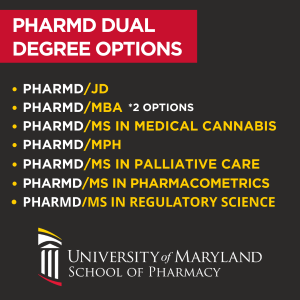 Whatever your goals and passions are, you can find the path to achieve them at the University of Maryland School of Pharmacy by customizing your Doctor of Pharmacy (PharmD) with a dual degree.
- JD (University of Maryland Francis King Carey School of Law)
- MBA JHU (Johns Hopkins Carey School of Business)
- MBA UB (University of Baltimore Merrick School of Business)
- MBA UM (University of Maryland Robert H. Smith School of Business)
- MPH (University of Maryland School of Medicine)
- MS Medical Cannabis
- MS Regulatory Science
- PhD Pharmaceutical Health Services Research
- PhD Pharmaceutical Sciences
The School of Pharmacy offers a variety of dual degrees for students enrolled in the PharmD program who want to further expand their education and their career opportunities.
Learn More About Dual Degrees